
Anúncios
Learning to play the accordion opens up a world of musical possibilities, from traditional folk melodies to contemporary genres that showcase this versatile instrument’s unique charm.


The accordion has captivated audiences for generations with its distinctive sound and expressive capabilities. Whether you’re drawn to polka rhythms, French musette, Cajun two-steps, or modern fusion styles, mastering this instrument rewards dedicated learners with a lifetime of musical enjoyment.
Starting your accordion journey might seem daunting at first, but with proper guidance and consistent practice, you’ll discover that this beautiful instrument becomes an extension of your musical voice. Let’s explore everything you need to know to begin your accordion adventure successfully.
🎵 Understanding the Accordion and Its Different Types
Before diving into lessons, it’s essential to understand what type of accordion suits your musical goals. The accordion family includes several distinct variations, each with unique characteristics that cater to different musical styles.
The piano accordion features a keyboard similar to a piano on the right side, making it familiar for those with piano experience. This type dominates in classical, jazz, and contemporary music settings. Its intuitive layout allows for melodic expression while the left hand manages bass notes and chord buttons.
Button accordions come in two main systems: chromatic and diatonic. Chromatic button accordions offer a compact layout with buttons arranged in rows, providing access to all chromatic notes. Diatonic accordions produce different notes depending on whether you’re pushing or pulling the bellows, making them popular in folk traditions worldwide.
Concertinas represent another branch of the free-reed family, typically smaller and held differently than standard accordions. While related, they require distinct techniques and are particularly beloved in English, Irish, and maritime musical traditions.
🛒 Choosing Your First Accordion
Selecting the right instrument dramatically affects your learning experience. Quality matters more than size when starting out, so invest wisely in an accordion that will support your progress rather than hinder it.
For beginners, a 48-bass or 60-bass piano accordion strikes an excellent balance between functionality and manageability. These instruments provide enough range for most beginner and intermediate repertoire without the weight and complexity of full-size 120-bass models.
Consider purchasing from reputable music stores or accordion specialists who can assess the instrument’s condition. A well-maintained used accordion from a quality manufacturer often surpasses a cheaper new model in both sound quality and durability.
Weight becomes a practical consideration since you’ll hold the instrument during practice sessions. Lighter models reduce physical strain, especially during extended playing periods. However, extremely lightweight accordions sometimes sacrifice sound quality, so test several options before deciding.
The accordion should respond smoothly when you operate the bellows, with buttons or keys that press evenly without sticking. Check for air leaks by compressing the bellows with the air button released—the bellows should hold their position without collapsing.
🎹 Essential Accordion Anatomy and Mechanics
Understanding how your accordion produces sound helps you develop proper technique and care for your instrument effectively. The accordion operates through free reeds that vibrate when air flows across them, similar to a harmonica.
The right hand section contains either piano keys or buttons that play individual melody notes. Each key or button opens a valve that allows air to reach specific reeds tuned to particular pitches. Multiple reed sets create the accordion’s characteristic rich, full sound.
Your left hand operates the bass and chord buttons arranged in a standardized pattern called the Stradella system on most accordions. This system organizes buttons in rows representing bass notes, major chords, minor chords, seventh chords, and diminished chords.
The bellows serve as the accordion’s lungs, controlling dynamics and phrasing. Learning proper bellows technique separates beginners from advancing players. Smooth, controlled bellows movement creates even tone, while deliberate changes produce expressive dynamics.
Register switches modify the sound by activating different reed combinations. These switches, located near the keyboard or grille, allow you to change tone colors from bright and reedy to mellow and flute-like, expanding your expressive palette.

💪 Developing Proper Posture and Holding Technique
Correct posture prevents fatigue and injury while enabling technical freedom. Sit on a firm chair without arms, positioned near the edge so the accordion can rest comfortably against your body without restriction.
The accordion sits on your left thigh with the bass section against your body. Shoulder straps distribute weight evenly across both shoulders—adjust them so the instrument sits high enough that your arms bend comfortably at the elbows rather than stretching downward.
Your back should remain straight but relaxed, avoiding the temptation to hunch forward over the instrument. Good posture allows unrestricted breathing, which becomes especially important during longer playing sessions or performances.
Position the keyboard section so your right hand naturally falls onto the keys or buttons without stretching or cramping. Your wrist should maintain a neutral position, neither bent upward nor downward excessively.
The left hand slides through a strap behind the bass buttons, allowing your fingers to reach across the button field while your thumb remains outside, operating the air button. This strap should fit snugly but not restrict circulation.
🎼 Mastering Basic Bellows Control
Bellows technique forms the foundation of good accordion playing. Think of bellows control as similar to bow technique for string instruments or breath control for wind instruments—it directly shapes your musical expression.
Begin by practicing opening and closing the bellows smoothly without playing any notes. Focus on maintaining steady pressure that produces consistent air flow. Jerky or uneven bellows movement creates unwanted accents and disrupts musical phrasing.
The bellows should move perpendicular to your body, neither tilting up nor down. Imagine guiding the bellows along invisible rails extending straight out from your torso. This alignment ensures all reeds receive equal air pressure.
Learn to change bellows direction smoothly during sustained notes. This technique, called bellows changes, requires coordination—you’ll momentarily increase pressure just as you reverse direction, maintaining continuous sound without gaps or accents.
Practice exercises that develop independence between bellows movement and finger articulation. Play simple scales while consciously controlling your bellows speed separately from your note rhythm. This separation enables sophisticated musical phrasing.
🎯 Right Hand Technique and Finger Positioning
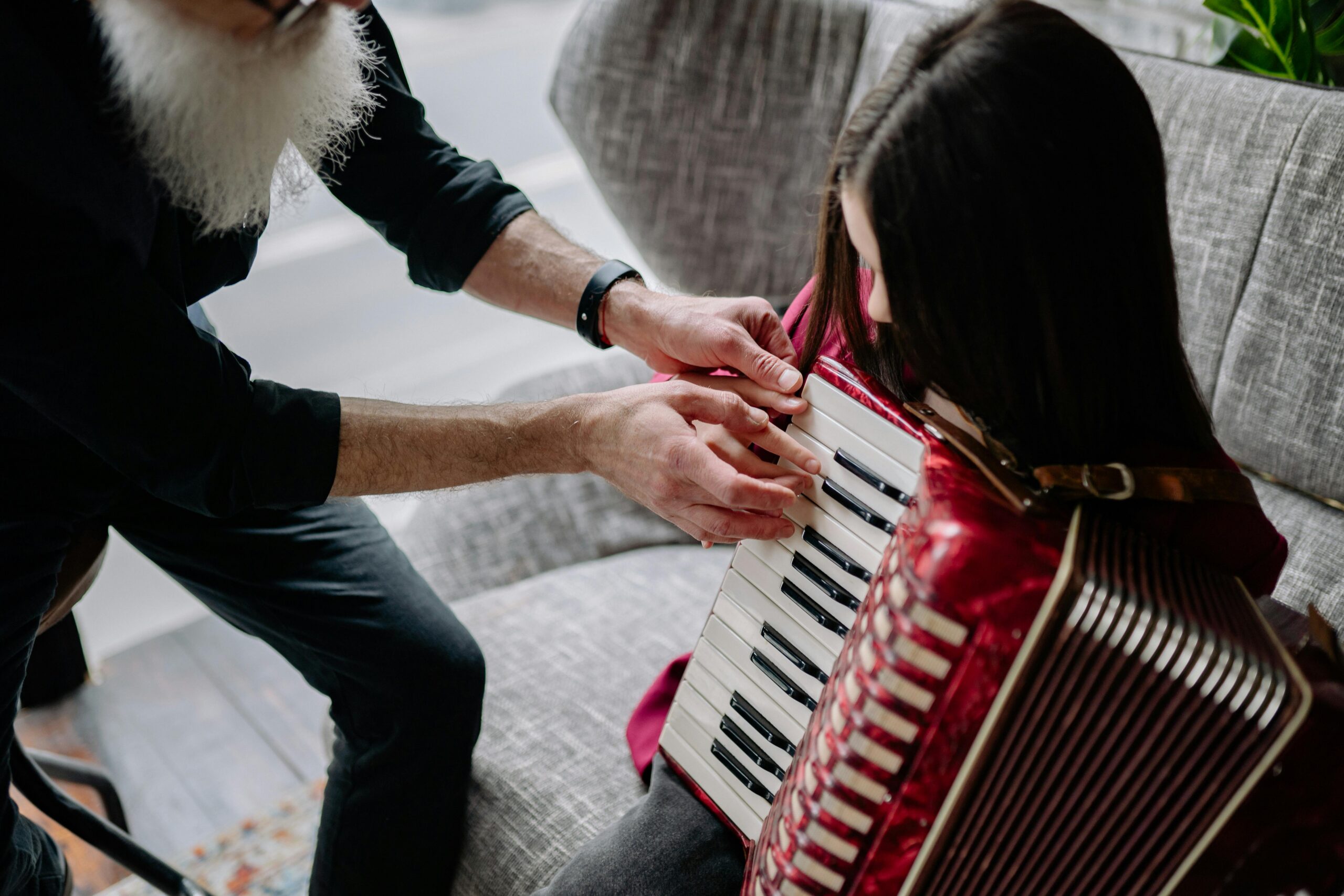
Your right hand plays melodies, requiring precision and agility. Curved fingers positioned over the keys or buttons allow quick, accurate movement between notes while maintaining relaxed hand position.
Piano accordion players benefit from piano technique fundamentals—play with rounded fingers using the fingertips rather than flat fingers. This position provides better control and enables faster passages as you advance.
Finger numbering follows standard musical convention: thumb is 1, index finger is 2, middle finger is 3, ring finger is 4, and pinky is 5. Logical fingering choices make difficult passages manageable, so pay attention to fingering suggestions in method books.
Button accordion technique differs slightly since buttons require less vertical travel than piano keys. Players develop a lighter touch, with fingers hovering just above the buttons for rapid sequences. The compact layout allows covering more musical range with less hand movement.
Practice scales and simple melodies slowly at first, focusing on even tone and smooth finger transitions. Speed develops naturally through repetition—rushing early leads to sloppy technique that’s harder to correct later.
👈 Left Hand Bass and Chord Fundamentals
The left hand Stradella bass system follows a logical pattern once you understand its organization. The third and fourth rows (counting from the bellows) contain the counterbass and bass notes, while the outer three rows hold chords.
Bass buttons arranged in the circle of fifths let you find related notes quickly. Once you memorize the pattern, you can navigate the bass board without looking, developing the touch sensitivity necessary for confident playing.
Start by locating the reference button, usually marked with a dimple or different texture. This landmark, typically the C bass note, helps you orient yourself on the bass board without visual reference.
Practice simple bass-chord patterns called “oompah” patterns, alternating between a bass note and its major chord. This foundational accompaniment pattern appears in countless musical styles and develops coordination between bass buttons.
As you progress, explore minor, seventh, and diminished chords located in the outer rows. Understanding harmonic relationships makes chord progressions feel intuitive rather than like random button combinations.
📚 Effective Practice Strategies for Consistent Progress
Regular practice matters more than marathon sessions. Twenty to thirty minutes daily produces better results than occasional multi-hour practices. Consistency builds muscle memory and reinforces neural pathways that coordinate the complex movements accordion playing requires.
Structure your practice time thoughtfully. Begin with warm-up exercises that review bellows control and basic scale patterns. This preparation phase gets your body and mind ready for focused learning.
Divide remaining practice time between reviewing previously learned material and introducing new concepts. This balance reinforces existing skills while expanding your capabilities. Solidifying fundamentals prevents developing bad habits that limit future progress.
Slow, deliberate practice builds accuracy. When learning new pieces, play slowly enough that you can execute every note cleanly. Gradually increase tempo only after achieving consistent accuracy at slower speeds.
Record yourself periodically to identify areas needing improvement. Listening objectively reveals issues you might not notice while playing. This feedback helps direct your practice toward specific weaknesses.
🎶 Learning Your First Songs and Melodies
Simple folk melodies provide excellent starting material for beginning accordionists. Tunes like “Ode to Joy,” “When the Saints Go Marching In,” or traditional folk songs from various cultures offer recognizable melodies that sound satisfying even at basic skill levels.
Choose pieces within your current ability that still present slight challenges. Music that’s too difficult frustrates, while pieces that are too easy don’t promote growth. The ideal difficulty level lets you succeed with focused effort.
Break complex pieces into smaller sections, mastering each segment before connecting them. This approach, called chunking, makes learning manageable and builds confidence through incremental successes.
Learn the melody first with your right hand before adding left hand accompaniment. Once the melody feels comfortable, introduce simple bass patterns. Eventually, coordinate both hands for the complete arrangement.
Don’t rush through pieces. Musical maturity comes from playing expressively, not just hitting correct notes. Focus on phrasing, dynamics, and emotional communication once you’ve learned the notes.
🎓 Learning Resources and Educational Materials
Quality instruction accelerates your learning curve significantly. Private lessons with an experienced accordion teacher provide personalized feedback and correct problems before they become ingrained habits.
If in-person instruction isn’t available, online accordion courses offer structured curricula taught by professional accordionists. Video lessons let you observe proper technique from multiple angles and replay difficult concepts.
Method books like the Palmer-Hughes Accordion Course or Mel Bay’s accordion series provide progressive lesson sequences that build skills systematically. These resources include exercises, songs, and technical explanations appropriate for self-study.
Mobile applications offer supplementary practice tools. Apps can help you learn the bass button layout, provide backing tracks for practice, or even simulate accordion playing for on-the-go learning when your instrument isn’t accessible.
Join accordion communities online or locally to connect with fellow learners and experienced players. These communities share resources, answer questions, and provide encouragement during challenging learning phases.
🔧 Maintaining Your Accordion in Peak Condition
Proper maintenance extends your accordion’s lifespan and ensures optimal performance. Store your instrument in its case when not playing to protect it from dust, humidity extremes, and accidental damage.
Keep your accordion away from direct sunlight, radiators, and air conditioning vents. Temperature and humidity fluctuations affect tuning and can damage reeds, bellows leather, and wax that secures internal components.
Clean the exterior regularly with a soft, dry cloth. Avoid harsh chemicals or excessive moisture that might damage finishes or penetrate into the instrument. The keyboard or buttons can be cleaned gently with slightly damp cloth when necessary.
Have your accordion serviced by a qualified technician every few years, or sooner if you notice problems. Professional maintenance includes tuning, bellows inspection, valve adjustment, and internal cleaning that preserves your instrument’s value and playability.
Transport your accordion carefully in a padded case. Even minor impacts can knock reeds out of tune or damage delicate mechanisms. Handle your instrument with the same care you’d give any valuable, precision-crafted object.
🎭 Exploring Different Musical Styles on Accordion
The accordion’s versatility spans virtually every musical genre. Traditional European folk music from France, Germany, Italy, and Eastern Europe showcases the accordion’s cultural heritage with distinctive regional styles.
Cajun and Zydeco music from Louisiana features diatonic accordion prominently, creating infectious dance rhythms that blend French, African, and Caribbean influences. These styles emphasize rhythm and groove alongside melodic expression.
Tango argentino wouldn’t exist in its current form without the bandoneón, a close accordion relative. Learning tango arrangements develops sophisticated harmonic understanding and dramatic expressiveness.
Contemporary accordion players incorporate the instrument into rock, pop, jazz, and experimental music. Artists like those in modern accordion ensembles demonstrate the instrument’s potential beyond traditional contexts.
Don’t limit yourself to one style. Exploring diverse musical genres develops well-rounded musicianship and keeps practice sessions engaging. Each style emphasizes different technical aspects that contribute to comprehensive accordion mastery.
🌟 Overcoming Common Beginner Challenges
Coordination between hands while managing bellows initially feels overwhelming. This challenge affects every beginner, so don’t get discouraged. Your brain adapts through practice, gradually making complex coordination feel natural.
Physical fatigue, especially in shoulders and left arm, commonly affects new players. Build endurance gradually, taking breaks during practice when needed. Proper posture and strap adjustment minimize unnecessary strain.
Finding bass buttons without looking requires developing tactile sensitivity. Practice bass patterns blindfolded or with eyes closed to accelerate learning the button layout through touch alone.
Reading bass notation while remembering button positions challenges beginners. Create reference charts showing the bass button layout alongside standard musical notation until the correlation becomes automatic.
Maintaining steady rhythm while concentrating on notes and bellows takes time. Practice with a metronome to develop internal timing, starting very slowly and gradually increasing tempo as coordination improves.
🚀 Setting Goals and Measuring Your Progress
Establish specific, achievable goals to maintain motivation and track improvement. Rather than vague aims like “get better,” set concrete objectives such as “learn three new songs this month” or “master left hand chord progressions in all major keys.”
Keep a practice journal documenting what you work on, challenges encountered, and breakthroughs achieved. This record helps you recognize progress that might otherwise feel invisible during daily practice.
Periodically record performances of pieces you’ve been practicing. Comparing recordings over weeks or months provides tangible evidence of improvement that encourages continued effort.
Consider working toward performance opportunities, even informal ones. Playing for family, friends, or at community events provides meaningful goals that motivate focused practice.
Celebrate milestones along your learning journey. Completing a method book, mastering a challenging piece, or successfully performing publicly represents significant achievement worth acknowledging.
🎪 Performing and Sharing Your Music
Performance transforms private practice into shared musical experiences. Start with low-pressure situations like playing for household members before progressing to larger audiences.
Open mic nights, community events, and local gatherings often welcome accordion players. These venues provide supportive environments for developing performance confidence and stage presence.
Prepare thoroughly for performances by practicing your repertoire beyond technical proficiency. Perform complete run-throughs of your program, simulating performance conditions to build reliability under pressure.
Stage fright affects most musicians regardless of experience level. Manage performance anxiety through adequate preparation, breathing exercises, and remembering that audiences want you to succeed.
Video your performances and share them on social media or video platforms if comfortable doing so. Documenting your musical journey inspires others while creating lasting memories of your progress.
🌈 Embracing the Accordion Community
Connecting with fellow accordion enthusiasts enriches your musical journey immeasurably. Accordion clubs and societies exist in many regions, offering workshops, festivals, and regular gatherings.
Attend accordion festivals and concerts to hear professional players and discover new repertoire. These events inspire continued learning and expose you to the accordion’s full artistic potential.
Online forums and social media groups connect you with accordionists worldwide. These communities generously share advice, resources, and encouragement that support your development.
Consider ensemble playing once you’ve developed basic proficiency. Accordion orchestras and mixed ensembles provide collaborative musical experiences that develop different skills than solo practice.
Share your knowledge as you progress by helping newcomers who are just beginning. Teaching reinforces your understanding while contributing to the accordion community’s growth and vitality.
✨ The Lifelong Journey of Musical Growth
Learning accordion opens doors to lifelong musical enjoyment and personal growth. The journey never truly ends—even professional accordionists continually refine their craft and explore new musical territories.
Embrace the process rather than fixating solely on outcomes. The hours spent practicing, the small daily improvements, and the joy of making music constitute the real rewards of learning any instrument.
Your relationship with the accordion will evolve as you grow as a musician. Pieces that once seemed impossible become manageable, and musical concepts that confused you initially become second nature.
The skills you develop—discipline, patience, coordination, and artistic expression—extend beyond music into other life areas. Musical study cultivates qualities that enrich your entire existence.
Whether you aspire to professional performance or simply want to enjoy making music for personal satisfaction, the accordion offers a uniquely rewarding musical path. Your dedication and passion determine how far this journey takes you, and the destination is limited only by your imagination and commitment to continuous growth.
