
Anúncios
The accordion is more than just a musical instrument—it’s a vibrant cultural icon that has captivated audiences across continents for nearly two centuries.


From bustling street corners in Paris to festive polka halls in Texas, the accordion has woven itself into the fabric of diverse musical traditions. Its distinctive bellows-driven sound evokes emotions ranging from nostalgic melancholy to unbridled joy, making it an instrument beloved by musicians and listeners alike.
Anúncios
Whether you’re drawn to the romantic waltzes of French musette, the energetic rhythms of Tejano music, or the soulful strains of Eastern European folk songs, understanding the accordion opens doors to a world of musical heritage. Let’s explore the fascinating journey of this remarkable instrument and discover why it continues to enchant new generations of music enthusiasts.
🎵 The Birth of a Musical Revolution
The accordion emerged in early 19th-century Europe, with several inventors simultaneously developing similar concepts. Christian Friedrich Ludwig Buschmann created an early version called the “handäoline” in Berlin around 1822, while Cyrill Demian patented his “accordion” in Vienna in 1829. This convergence of creativity sparked a musical revolution that would spread worldwide.
What made the accordion revolutionary was its portable nature combined with harmonic capabilities. Unlike previous instruments that required considerable space or multiple musicians to achieve full harmonic accompaniment, the accordion placed orchestra-like potential in the hands of a single player. This democratization of music-making transformed how communities experienced musical entertainment.
Anúncios
The instrument’s design ingeniously utilized free reeds—thin metal tongues that vibrate when air flows across them. By compressing and expanding the bellows, players could sustain notes indefinitely, creating a singing quality that distinguished the accordion from plucked or struck instruments. This continuous sound production became the accordion’s signature characteristic.
🌍 Cultural Journeys Across Continents
As European immigrants traveled to new lands throughout the 19th and 20th centuries, they carried their accordions with them. These instruments became cultural ambassadors, adapting to local musical traditions while retaining their essential character. In each region, the accordion found new voices and purposes.
In France, the accordion became synonymous with Parisian street life and café culture. The musette style, with its distinctive swing and chromatic runs, painted sonic portraits of romantic evenings along the Seine. Legendary players like Yvette Horner and André Verchuren elevated the instrument to concert hall status while maintaining its working-class roots.
Meanwhile, in Eastern Europe, the accordion became the heartbeat of village celebrations and folk traditions. Polish, Russian, and Ukrainian communities embraced button accordions for their bright, penetrating sound that could cut through noisy festivities. The instrument’s portability made it ideal for traveling musicians who brought entertainment to remote communities.
The Accordion Conquers the Americas 🎺
When accordions arrived in the Americas, they underwent fascinating cultural transformations. In Mexico and the American Southwest, German immigrants introduced the instrument to indigenous and mestizo populations. This cross-pollination birthed conjunto and Tejano music, where the accordion became the lead voice in a distinctly new American sound.
Pioneers like Narciso Martínez and Santiago Jiménez Sr. developed playing techniques that emphasized the instrument’s treble register, creating the characteristic bright, dancing sound of norteño music. Today, artists like Flaco Jiménez continue this tradition, proving the accordion’s ongoing relevance in contemporary Latin music.

In Louisiana, Cajun and Zydeco musicians adopted the accordion as their signature instrument. The single-row diatonic accordion became essential to Cajun music’s driving rhythms, while Creole musicians favored the piano accordion for zydeco’s more complex harmonic structures. Artists like Clifton Chenier transformed the accordion into an instrument of soul and intensity.
South America also embraced the accordion with passion. Colombian vallenato music centers entirely around the accordion’s melodic capabilities, with virtuosos like Alejo Durán and Francisco “El Hombre” Moscote achieving legendary status. In Argentina, the bandoneón—a cousin of the accordion—became inseparable from tango, giving that genre its characteristic yearning sound.
🔧 Understanding Accordion Varieties
Not all accordions are created equal. The instrument family includes several distinct types, each with unique characteristics suited to different musical styles. Understanding these variations helps appreciate the accordion’s versatility and complexity.
Piano Accordion: The Versatile Workhorse
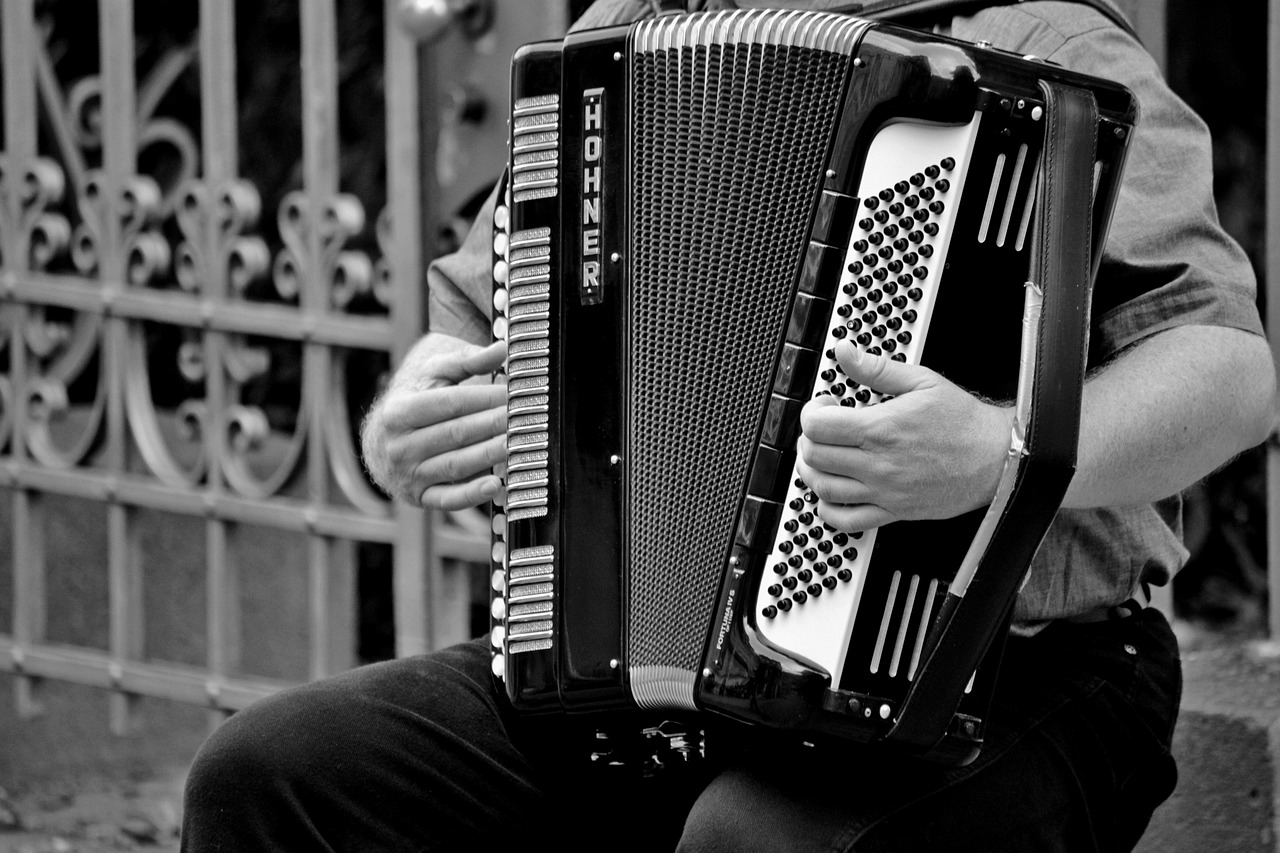
The piano accordion features a keyboard layout identical to a piano on the right hand, making it accessible to pianists. The left hand operates buttons that produce bass notes and pre-arranged chords, allowing players to create complete harmonic accompaniment. This design makes the piano accordion extremely versatile across musical genres.
Modern piano accordions range from compact 48-bass models suitable for beginners to massive 120-bass concert instruments weighing over 20 pounds. Professional models often feature multiple reed sets called “registers” that can be switched to produce different tonal colors, from bright and reedy to warm and orchestral.
Button Accordion: Traditional Precision ✨
Button accordions use buttons for both hands rather than a piano keyboard. This design offers several advantages, including more compact size and the ability to pack more notes into a smaller space. Chromatic button accordions are particularly popular in classical and Eastern European folk music.
Diatonic button accordions, which produce different notes when pushing versus pulling the bellows, remain favorites in folk traditions worldwide. These instruments encourage particular playing styles and rhythmic patterns that define genres like Irish traditional music, Mexican conjunto, and Alpine folk music.
Concertina and Bandoneón: Specialized Cousins
Concertinas feature hexagonal ends with buttons arranged in various systems. English, Anglo, and Duet concertinas each have different note layouts serving different musical purposes. English concertinas excel at melody playing, while Anglo concertinas suit traditional dance music with their bellows-direction sensitivity.
The bandoneón, developed specifically in Germany but adopted wholeheartedly in Argentina, has a unique square shape and complex button arrangement. Its rich, melancholic tone became the voice of tango, with masters like Astor Piazzolla demonstrating its extraordinary expressive range in both traditional and contemporary compositions.
🎼 Learning to Play: A Journey Worth Taking
Beginning accordion study requires patience and dedication, but the rewards are substantial. Unlike instruments that produce immediate pleasant sounds, the accordion demands coordination between both hands, bellows control, and musical understanding. However, this complexity also means rapid progress brings deeply satisfying results.
New players typically start with simple folk songs and exercises designed to develop bellows technique. Smooth, controlled bellows movement separates amateur players from accomplished accordionists. Learning to maintain steady air pressure while changing bellows direction creates the seamless legato sound that makes melodies sing.
Left-hand bass technique presents unique challenges. The buttons are positioned out of the player’s sight, requiring muscle memory and spatial awareness. Standard bass systems follow logical patterns, but mastering these patterns takes consistent practice. Many teachers recommend starting with simple bass-chord accompaniments before attempting more complex harmonic progressions.
Modern Learning Resources 📚
Today’s accordion students enjoy advantages previous generations could only dream of. Online video tutorials allow learners to study with master accordionists regardless of geographic location. Platforms dedicated to accordion instruction offer structured curricula covering everything from absolute beginner levels to advanced performance techniques.
Digital technology has also created new practice tools. MIDI accordions can connect to computers and tablets, opening possibilities for silent practice with headphones, recording capabilities, and access to unlimited virtual sounds. These innovations make accordion learning more accessible and flexible than ever before.
🎭 The Accordion in Popular Culture
Despite facing periods of declining popularity, particularly during the rock and roll era, the accordion has maintained cultural presence through cinema, television, and contemporary music. Film composers frequently employ accordion to evoke specific atmospheres—romance, nostalgia, exoticism, or folk authenticity.
Movies set in Paris almost inevitably feature musette accordion in their soundtracks, instantly transporting audiences to cobblestone streets and sidewalk cafés. Similarly, Western films use accordion to suggest Mexican or frontier settings, while European period dramas incorporate the instrument to establish historical authenticity.
Contemporary artists across genres have rediscovered the accordion’s unique sonic qualities. Indie rock bands, electronic musicians, and folk revivalists incorporate accordion textures into arrangements, appreciating how the instrument adds organic warmth and distinctive character to modern productions.
Accordion Festivals and Community 🎉
Accordion festivals worldwide celebrate the instrument’s diversity and bring enthusiasts together. Events like the Coupe Mondiale in various international locations, the Cotati Accordion Festival in California, and countless regional gatherings showcase virtuoso performances while fostering community among players and fans.
These festivals typically feature competitions, workshops, jam sessions, and vendor areas where accordion builders and repair specialists display their craftsmanship. Attendees can try various accordion types, learn maintenance techniques, and connect with others who share their passion for this unique instrument.
🛠️ Accordion Craftsmanship and Maintenance
Quality accordions represent remarkable feats of precision engineering. A single instrument may contain thousands of individual parts, including hundreds of precisely tuned reeds, complex valve systems, and intricate mechanical linkages. Master accordion builders spend decades perfecting their craft, often working within family traditions spanning generations.
Italian manufacturers like Bugari, Scandalli, and Pigini remain revered for their concert-quality instruments, while German makers continue traditions established in the 19th century. These artisans hand-voice reeds—carefully filing and shaping them—to achieve specific tonal characteristics. This painstaking process explains why professional accordions command prices comparable to automobiles.
Proper maintenance ensures accordion longevity and optimal performance. Regular playing actually benefits the instrument by keeping reeds responsive and preventing leather components from drying out. However, accordions require periodic professional servicing to address tuning drift, replace worn felts and valves, and maintain airtight bellows.
🌟 The Accordion’s Future Looks Bright
Far from being a relic of the past, the accordion continues evolving and finding new audiences. Young virtuosos are pushing technical boundaries while exploring fusion genres that combine accordion with electronic music, jazz, classical, and world music traditions. Social media platforms allow these innovators to reach global audiences instantly.
Educational institutions increasingly recognize the accordion’s legitimacy as a concert instrument. Conservatories and universities offer accordion performance degrees, and competition circuits provide pathways for serious students to develop professional careers. This institutional support ensures continued high-level pedagogy and performance standards.
The digital accordion revolution promises to expand the instrument’s capabilities further. Electronic accordions with MIDI capability can trigger any sound imaginable while retaining the physical expressiveness of traditional bellows and keyboard control. This technology attracts musicians who might not have considered acoustic accordion, broadening the instrument’s appeal.
💫 Why the Accordion Still Matters
In an era of synthesized sounds and digital perfection, the accordion offers something increasingly precious—authentic human expression through mechanical means. The physical effort of pushing and pulling bellows, the tactile feedback of keys and buttons, and the organic variability of reed sounds create music that feels alive and immediate.
The accordion also serves as a cultural bridge, connecting contemporary listeners with folk traditions and immigrant histories. When someone picks up an accordion, they join a lineage stretching back nearly two centuries, touching countless cultural movements and musical innovations. This historical resonance gives accordion music a depth that transcends mere entertainment.
Moreover, the accordion community exemplifies music’s power to unite people across differences. Accordion gatherings bring together players of all ages, backgrounds, and skill levels, united by appreciation for this remarkable instrument. This inclusive spirit reflects music’s highest purpose—creating connection and shared joy.
Whether you’re considering learning accordion, deepening your appreciation as a listener, or simply curious about this fascinating instrument, the accordion offers endless discoveries. Its rich history, cultural diversity, and ongoing evolution make it a subject worthy of exploration. The accordion’s distinctive voice continues singing stories of human creativity, resilience, and the universal language of music that needs no translation. 🎶
